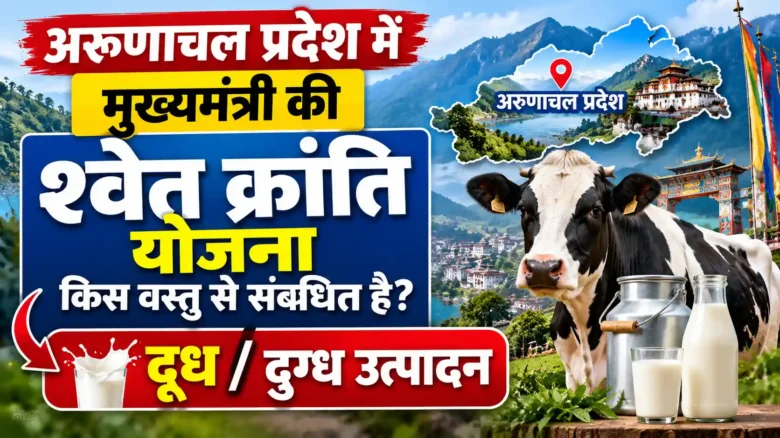
If you are exploring state government welfare initiatives or preparing for competitive examinations and wondering, “Arunachal Pradesh mein Mukhymantri ki Shwet Kranti Yojana kis vastu se sambandhit hai?” (Which commodity is the Chief Minister’s White Revolution Scheme related to in Arunachal Pradesh?), the direct answer is Milk and Dairy Products (दुग्ध एवं डेयरी उत्पाद).
As of October 2026, the Government of Arunachal Pradesh, headed by Chief Minister Pema Khandu, has significantly scaled up this ambitious livestock initiative to transform the agrarian landscape across the eastern Himalayan state. Designed to replicate the nationwide success of Operation Flood at the grassroots level, the Mukhyamantri Shwet Kranti Yojana aims to convert Arunachal Pradesh from a milk-deficit state into a self-reliant dairy economy.
Overview Highlights: Mukhyamantri Shwet Kranti Yojana 2026
Here is a detailed snapshot summarizing the core components of the Chief Minister’s White Revolution Scheme in Arunachal Pradesh as updated for the current fiscal cycle:
| Parameter | Details |
|---|---|
| Scheme Name | Mukhyamantri Shwet Kranti Yojana (Chief Minister’s White Revolution Scheme) |
| State | Arunachal Pradesh |
| Related Commodity / Sector | Milk, Cow/Buffalo Dairy Products, and High-Altitude Yak Dairy Farming |
| Nodal Department | Department of Animal Husbandry, Veterinary and Dairy Development (AHV&DD) |
| Target Beneficiaries | Individual Dairy Farmers, Self-Help Groups (SHGs), Farmer Producer Organizations (FPOs), and Rural Youth |
| Core Objective | Achieving Self-Reliance in Milk Production, Generating Rural Employment, and Enhancing Farmer Income |
| Financial Subsidy Model | Credit-linked back-ended subsidy (up to 50% capital subsidy depending on project unit size) |
| Current Status (2026) | Fully Operational with Expanded Chilling Hubs and High-Altitude Cattle Breeding Support |
Detailed Answer: Kis Vastu Se Sambandhit Hai (Which Commodity is it Linked To?)
The term Shwet Kranti literally translates to White Revolution, a phrase historically synonymous with the dramatic expansion of liquid milk production pioneered under Dr. Verghese Kurien in India. In Arunachal Pradesh, the Mukhymantri Shwet Kranti Yojana is strictly related to dairy development, liquid milk collection, and dairy products (such as paneer, curd, clarified butter/ghee, and indigenous fermented cheese like churpi).
Historically, Arunachal Pradesh has remained heavily reliant on neighboring states like Assam to meet its daily commercial demand for liquid milk and milk-based processed goods. Due to mountainous terrain, dispersed tribal settlements, and transportation bottlenecks, local milk procurement had remained unorganized. The Mukhyamantri Shwet Kranti Yojana was crafted specifically to bridge this supply-demand gap by empowering local livestock farmers with modern dairy cattle, feed subsidies, veterinary access, and localized milk processing units.
Key Objectives of the White Revolution Scheme in Arunachal Pradesh
The Government of Arunachal Pradesh initiated this welfare project with multi-dimensional socio-economic targets:
- Eliminating Milk Deficit: Boosting daily per capita milk availability to meet Indian Council of Medical Research (ICMR) dietary benchmarks across all 26 districts of the state.
- Income Augmentation for Pastoralists: Enabling marginal farmers, progressive livestock owners, and tribal youth to build profitable micro-enterprises through dairy rearing.
- Strengthening the Cold Chain Network: Deploying Bulk Milk Coolers (BMCs), refrigerated collection vans, and mini processing plants so raw milk does not spoil in remote terrains.
- Promoting High-Altitude Dairy (Yak and Mithun Conservation): Special focus in higher reaches such as Tawang, West Kameng, and Shi Yomi on indigenous bovine breeds and yak milk value-addition.
- Women Empowerment through Cooperatives: Mobilizing rural women into village-level dairy cooperative societies to manage daily sales, direct banking, and fodder storage.
Key Components & Subsidy Structure Available in 2026
Under the revised guidelines running through the 2026-2027 development roadmap, the state administration collaborates with nationalized banks, regional rural banks (such as the Arunachal Pradesh Rural Bank), and NABARD to deliver end-to-end assistance:
1. Induction of High-Yielding Bovine Breeds
Farmers receive subsidized loans to procure high-yielding indigenous cows (such as Gir and Sahiwal crossbred varieties) and temperate climate breeds (such as Jersey and Holstein Friesian crosses) well-suited to the state’s hilly ecosystems.
2. Financial Subsidies
The scheme offers a lucrative credit-linked back-ended subsidy, typically ranging between 40% and 50% of the total project expenditure for setting up small, medium, or community dairy farms. Beneficiaries only need to bear a nominal margin money contribution (often 10% to 15%), with commercial banks providing the remaining financing.
3. Feed, Fodder, and Veterinary Support
Recognizing the scarcity of quality animal feed in forested valleys, the scheme funds silage-making equipment, chaff cutters, seed distribution for perennial grasses, and mobile veterinary healthcare clinics directly to remote villages.
Socio-Economic Impact Across Arunachal Pradesh
As of late 2026, the Mukhyamantri Shwet Kranti Yojana has shown measurable improvements across pilot districts including Papum Pare, Lower Subansiri, Namsai, and East Siang. Local dairy farmers have organized into functional cooperative societies, allowing organized packaging and distribution to military garrisons, school mid-day meal programs, and town markets.
Furthermore, the initiative has successfully integrated geographic branding for ethnic dairy specialties. The popular Arunachali Yak Churpi, which earned prestigious Geographical Indication (GI) status in recent years, has benefited immensely from cold-chain funding sanctioned under the overarching Shwet Kranti umbrella, directly benefiting Brokpa pastoral communities.
How Eligible Farmers Can Apply
Farmers and unemployed youths residing in Arunachal Pradesh who wish to establish dairy micro-units under the Mukhyamantri Shwet Kranti Yojana can avail themselves of the scheme through the following process:
- Visit District Veterinary Office: Approach the District Animal Husbandry and Veterinary Officer (DAHVO) in your respective district headquarters.
- Project Proposal Submission: Choose an eligible dairy farm module (e.g., 2-cow unit, 5-cow unit, or 10-cow commercial unit) and fill out the standardized application form.
- Document Verification: Submit Land Possession Certificates (LPC), bank passbook details, Aadhaar card, and residential proof.
- Scrutiny & Bank Forwarding: The District Level Screening Committee reviews the application and forwards recommended proposals to participating commercial or cooperative banks for loan sanctioning and subsidy release.
Frequently Asked Questions (FAQs)
1. Arunachal Pradesh mein Mukhymantri Shwet Kranti Yojana kis vastu se sambandhit hai?
Yeh yojana mukhya roop se doodh aur dairy utpadon (Milk & Dairy Products) ke utpadan, procurement aur processing se sambandhit hai.
2. Who is the implementing department of this scheme in Arunachal Pradesh?
The scheme is executed by the Department of Animal Husbandry, Veterinary and Dairy Development (AHV&DD), Government of Arunachal Pradesh.
3. What is the main objective of the White Revolution Scheme in the state?
The primary aim is to make Arunachal Pradesh self-sufficient in milk production, reduce dependence on dairy imports from outside states, and generate sustainable livelihoods for rural youth and women.
4. Are high-altitude animals like Yaks included under dairy development schemes in Arunachal Pradesh?
Yes. Along with crossbred dairy cows, the state promotes high-altitude dairy farming, including yak milk procurement and processing for specialty products like Yak Churpi.
5. How much financial subsidy does a beneficiary receive under the scheme?
Depending on the farm size and category of the applicant, the scheme offers a credit-linked subsidy generally ranging up to 50% of the project cost, supported by partner banks and state welfare grants.