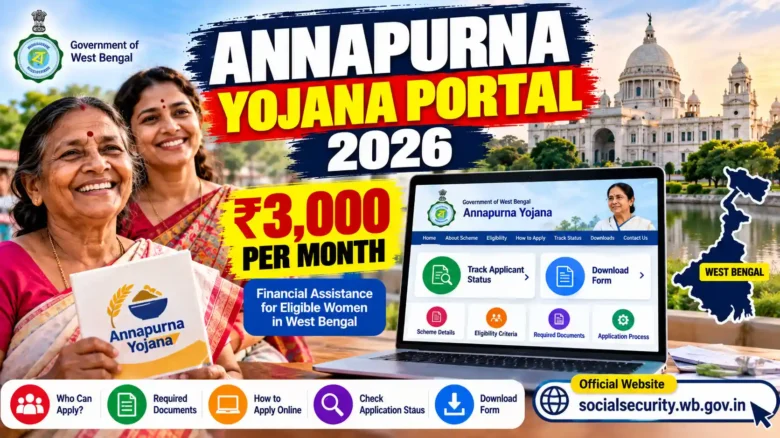
Ensuring targeted social welfare and eradicating nutritional vulnerability among low-income households and elderly citizens remains a foremost priority for welfare governance. As of October 2026, the Annapurna Yojana Portal has undergone significant technological upgrades to streamline the distribution of subsidized food grains, nutritional packets, and essential kitchen fuel benefits. The modernized digital infrastructure eliminates intermediaries, offers Aadhaar-enabled beneficiary tracking, and allows applicants to verify their enrolment status in real time.
Whether you are seeking new registration, attempting to download an e-card, or tracking the monthly disbursement schedule, the Annapurna Yojana Portal serves as a unified digital window. This comprehensive guide outlines the operational framework of the scheme, eligibility standards, step-by-step digital application steps, and key portal features as updated for the 2026–2027 fiscal cycle.
Overview Highlights: Annapurna Yojana 2026
Before initiating your digital application or status inquiry, review the essential administrative details outlined in the table below:
| Parameters | Scheme Details |
|---|---|
| Scheme Title | Annapurna Yojana (Unified Digital Portal) |
| Nodal Authority | Ministry of Consumer Affairs, Food & Public Distribution / State Civil Supplies Departments |
| Primary Objective | Providing subsidized food grains, ration kits, and nutritional security to destitute senior citizens and vulnerable households |
| Target Beneficiaries | Indigent elderly citizens (65+), BPL/AAY cardholders, and eligible low-income families |
| Application Mode | Online via State/Central Annapurna Portal & Offline via Common Service Centers (CSC) |
| Core Benefit | Up to 10 kg free food grains monthly per eligible beneficiary or subsidized ration kits/cooking support |
| Verification Framework | Biometric e-KYC, Aadhaar-linked Public Distribution System (PDS) |
| Current Operational Status | Active Phase (October 2026 Renewal & e-KYC Drive) |
What is the Annapurna Yojana Digital Portal?
The Annapurna Yojana portal was conceptualized to address the critical gaps in food safety networks. While traditional welfare architectures cater to broader below-poverty-line groups, the Annapurna framework is strategically customized to support individuals who frequently slip through standard pension nets—particularly destitute senior citizens aged 65 years and above who are eligible for social pensions like NOAPS (National Old Age Pension Scheme) but do not receive them due to quota saturation.
In its recent 2026 digital expansion, several state variants of the Annapurna Yojana (including free gas cylinder initiatives and nutritional food basket distributions) have been integrated into this consolidated monitoring interface. Through this portal, district food supply officers and citizens can monitor quota allocations, download dynamic QR-coded ration passes, and verify biometric authentications without visiting local revenue offices.
Key Eligibility Criteria for 2026 Applicants
Strict eligibility audits have been established on the Annapurna Yojana portal to guarantee that relief reaches the most deserving candidates without duplicity. The current eligibility conditions include:
- Age Criterion: The applicant must be 65 years of age or older at the time of standard Annapurna food grain registration. (For state-specific nutritional package or fuel variants, household income metrics apply).
- Economic Status: Applicants must be destitute, possessing no regular means of financial subsistence or support from adult family members.
- Exclusion Guidelines: Individuals currently drawing benefits from the National Social Assistance Programme (NSAP) pension or state social security pensions are generally excluded from the grain-only component to prevent overlapping welfare draws.
- Residency Verification: The applicant must be a bonafide resident of the administering state or union territory with valid permanent address documentation.
- Aadhaar Integration: The applicant must possess an active Aadhaar number linked with an operational bank account and mobile number for e-KYC compliance.
Mandatory Documents Required for Online Registration
Applicants and authorized CSC operators must have scanned copies of the following documents ready prior to initiating the digital workflow:
- Proof of Age (Birth Certificate, Voter ID, or Aadhaar Card)
- Proof of Residence (Domicile Certificate, Electricity Bill, or Gram Panchayat declaration)
- Income Certificate or Destitute Status Certificate certified by local revenue authorities (Tehsildar/BDO)
- Recent passport-sized photographs
- Active Mobile Number for OTP authentication
- Existing Ration Card copy (if applying for food basket/subsidy category transitions)
Step-by-Step Guide: How to Apply on the Annapurna Yojana Portal
Registering on the portal has been simplified under the Digital India 2026 governance framework. Follow these sequential steps to complete your submission:
Step 1: Access the Official Portal
Navigate to the designated state or national Annapurna Public Distribution portal using any updated web browser. Look for the citizen services tab on the landing dashboard.
Step 2: Citizen Registration
Select the “New Citizen Registration” link. Enter your active mobile number and enter the OTP sent to your phone. Create a secure password to generate your citizen login profile.
Step 3: Access Application Form
Log in with your newly created credentials. Select the “Annapurna Welfare Scheme Application (2026–27)” option from the active schemes drop-down menu.
Step 4: Fill Personal and Socio-Economic Details
Carefully input the applicant’s name, date of birth, complete postal address, ward/village details, and demographic parameters. Verify spelling precisely as registered on your Aadhaar card to avoid mismatch errors during automated validation.
Step 5: Document Upload & e-KYC
Upload clean PDF or JPG copies of your age, income, and residential certificates. Complete Aadhaar e-KYC through the UIDAI integration widget via an OTP or connected biometric scanner.
Step 6: Submission and Acknowledgement Receipt
Review the application preview carefully. Click “Submit Application.” Once submitted, a distinctive 15-digit Application Tracking ID will be generated. Download and print the digital acknowledgement receipt for future reference.
How to Check Annapurna Yojana Beneficiary Status Online
Citizens who have previously enrolled can track the sanctioning status of their application within minutes:
- Visit the official Annapurna Yojana portal.
- Click on the “Track Application / Beneficiary Status” tab visible on the top navigation bar.
- Choose your search parameter: Application Number, Aadhaar Number, or Ration Card Reference.
- Enter your security Captcha and click “Search.”
- The system will display the current status: Under Verification, Approved, Field Verification Pending, or Benefit Disbursed.
Frequently Asked Questions (FAQs)
1. What primary benefit is provided under the Annapurna Yojana?
Under the conventional central framework, selected destitute senior citizens are entitled to receive 10 kg of food grains (wheat/rice) entirely free of charge every month. State-specific extensions may include cooking gas subsidies or fortified nutritional food kits.
2. Can a person receiving a monthly old-age pension apply for this scheme?
No. Under standard regulatory provisions, if an applicant is already drawing benefits under the National Old Age Pension Scheme (NOAPS) or related state social security pension schemes, they are not eligible for the free food grain quota of Annapurna Yojana.
3. What should I do if my application is rejected on the portal?
If an application is rejected, log in to view the objection remarks. Common grounds include document illegibility or income threshold discrepancies. You may upload revised documents through the grievance redressal module or submit a physical rectification request at your local Block Development Office (BDO) or Civil Supplies Department.
4. Is offline registration still available in 2026?
Yes. Citizens unable to navigate digital portals independently can visit authorized Common Service Centers (CSC), Gram Panchayat Suvidha Kendras, or local Fair Price Shops (FPS) to get their applications processed through biometric assisted systems.
5. How often must beneficiaries complete e-KYC authentication?
To avoid bogus entries and ghost beneficiary allocations, authorities mandate an annual or bi-annual biometric e-KYC update, which can be completed via life certification portals, facial authentication apps, or CSC centers.