
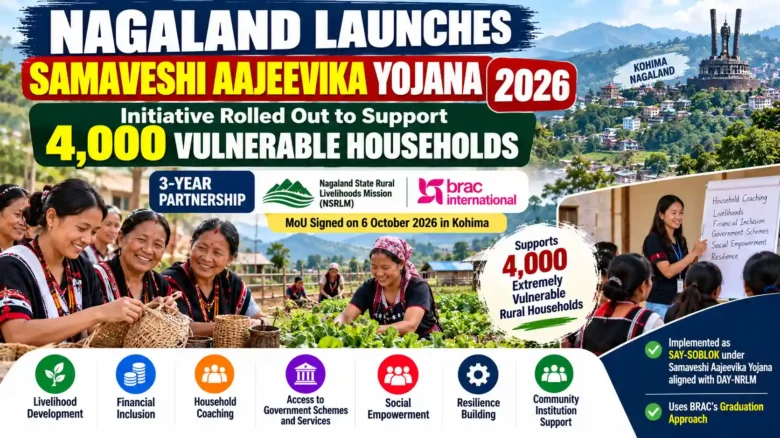
In a major boost to inclusive rural development and community empowerment, the State Government of Nagaland has officially launched the Samaveshi Aajeevika Yojana. The specialized scheme is specifically designed to provide tailored livelihood interventions and socio-economic support to 4,000 vulnerable households across the state. The announcement, reported by News On AIR, marks a critical step toward addressing structural poverty and ensuring that ultra-poor and marginalized families in remote hill districts are integrated into sustainable economic streams.
Overview Highlights: Samaveshi Aajeevika Yojana
The following summary table outlines the core parameters of the newly launched scheme based on available government disclosures and news updates:
| Parameter | Details |
|---|---|
| Scheme Name | Samaveshi Aajeevika Yojana (Inclusive Livelihood Scheme) |
| State | Nagaland |
| Target Coverage | 4,000 Vulnerable Households |
| Core Objective | Socio-economic inclusion, sustainable livelihood creation, and capacity enhancement |
| Primary Target Group | Ultra-poor, vulnerable, and economically marginalized rural families |
| Reporting Date | October 2026 |
| Primary Implementation Agency | Rural Development Sector / State Rural Livelihoods Mission Framework |
| Official Media Report | News On AIR Coverage |
Understanding the Samaveshi Aajeevika Yojana
The term Samaveshi Aajeevika translates directly to “Inclusive Livelihoods.” Across rural development frameworks in India, inclusive livelihood programs are engineered to reach households that frequently slip through the gaps of conventional poverty-alleviation initiatives. While standard Self-Help Group (SHG) networks and micro-credit programs serve large segments of the rural populace, households facing extreme vulnerability—such as female-headed families, elderly breadwinners, persons with disabilities, and land-poor laborers—often require intensive, graduated assistance.
By prioritizing 4,000 vulnerable households, the Nagaland government is directing focused resources to build resilience at the grassroots level. This intervention is expected to align closely with rural livelihood mission paradigms, utilizing customized asset-building strategies and dedicated community handholding to graduate families out of extreme vulnerability.
Key Pillars of the Intervention
1. Targeted Household Identification
Unlike universal welfare distribution, targeted schemes rely on participatory identification processes. Village-level institutions, local community councils, and grassroots organizations are instrumental in identifying the 4,000 target households based on multi-dimensional vulnerability metrics rather than broad income categorizations alone.
2. Livelihood Diversification and Asset Transfer
In rural Nagaland, agricultural activities, agro-forestry, and traditional allied sectors (such as livestock rearing, weaving, and horticulture) form the backbone of household survival. The Samaveshi Aajeevika Yojana is structured to diversify income portfolios, helping families establish micro-enterprises, small livestock units, or farm-allied value-addition projects that generate consistent cash flow.
3. Skill Building and Intensive Mentorship
Asset allocation alone rarely guarantees long-term economic independence. The program emphasizes continuous capacity enhancement, basic financial literacy, bookkeeping, and localized technical training. Community resource persons (CRPs) and local mentors typically provide step-by-step guidance to ensure that supported households sustain their income-generating activities.
4. Financial Inclusion and Convergence
A crucial aspect of modern inclusive programming involves connecting beneficiaries with existing welfare schemes, social security pensions, health coverage, and formal banking systems. The scheme seeks to build a comprehensive safety net around the 4,000 households to protect them from external economic shocks, such as natural calamities or health emergencies.
Strategic Significance for Nagaland’s Rural Economy
Nagaland presents unique geographic, cultural, and economic dynamics. Rugged hill terrain, dispersed hamlets, and transportation constraints often make centralized economic initiatives less effective in reaching the deepest pockets of rural distress. Community cohesion and customary village institutions (such as Village Development Boards and traditional village councils) provide a robust foundation for community-driven development.
By deploying the Samaveshi Aajeevika Yojana across selected districts, state authorities aim to reduce regional disparities and foster inclusive growth. Empowering 4,000 families with regular income pathways directly enhances household nutrition, education access for children, and local economic resilience.
Expected Rollout and Implementation Roadmap
With the official announcement confirmed in mid-October 2026, the rollout phase involves key operational steps:
- Baseline Mapping and Verification: Finalizing household lists through participatory rural appraisals and village council consultations.
- Enterprise and Skill Needs Assessment: Mapping available local resources, market demand, and household capacities to assign viable livelihood options.
- Resource Mobilization: Channeling financial assistance, productive tools, or starter kits to selected beneficiaries.
- Monitoring and Milestone Tracking: Institutional tracking mechanisms to evaluate household progress, income increments, and financial self-sufficiency over designated project periods.
Frequently Asked Questions (FAQs)
1. What is the Nagaland Samaveshi Aajeevika Yojana?
The Samaveshi Aajeevika Yojana is a specialized livelihood initiative launched by the State Government of Nagaland to uplift, support, and secure sustainable livelihoods for 4,000 vulnerable and marginalized rural households.
2. How many households will benefit under this scheme?
According to the official launch announcement reported by News On AIR, the initial phase of the scheme directly covers 4,000 identified vulnerable households across the state.
3. What types of support does the program typically provide?
The program focuses on inclusive livelihood promotion, which generally includes productive asset creation, skill development, micro-enterprise training, financial inclusion, and continuous community-level mentorship.
4. How are beneficiary households identified?
Beneficiaries are determined through vulnerability assessments and community-level participation, prioritizing households facing acute economic distress, marginalization, or lack of formal livelihood access.
5. Where can official updates about the scheme be accessed?
Updates on the implementation of the Samaveshi Aajeevika Yojana are disseminated via state rural development department announcements and public service broadcasts, including News On AIR.
