
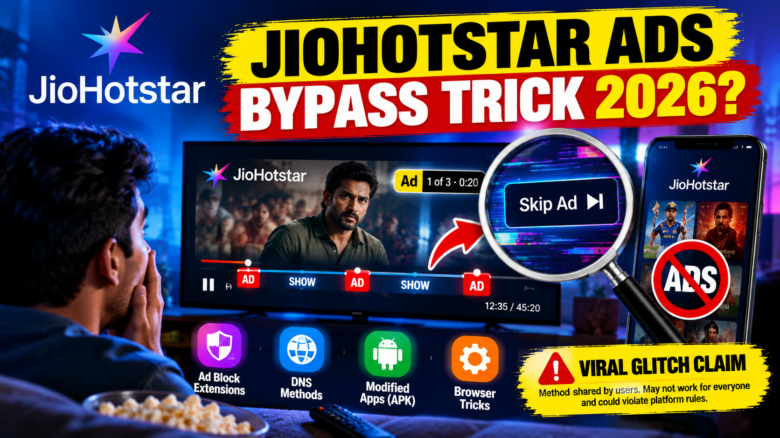
In the rapidly consolidating Indian streaming ecosystem, Jio Hotstar has emerged as an undisputed entertainment behemoth. Following the multi-billion-dollar merger that unified Viacom18 and Disney Star, the unified platform commands millions of daily active users tuning in for live sports, regional cinema, and blockbuster international releases. However, the platform’s aggressive monetization shift marked by frequent, unskippable mid-roll commercials even on lower-tier paid subscription plans has sparked widespread consumer pushback.
Over the past few weeks leading into October 2026, tech-savvy subscribers on forums like Reddit, Telegram, and X (formerly Twitter) have discovered and popularized several technical workarounds to completely bypass or neutralize ads on Jio Hotstar.
While digital ad circumvention is nearly as old as online streaming itself, the current wave of methods targets vulnerabilities across server-side ad insertion protocols, DNS sinkholing, and automated browser scripting. Here is an in-depth breakdown of how users are executing these ad-skipping methods, the architecture behind them, and how JioStar’s engineering teams are preparing to shut them down.
Overview Highlights: Jio Hotstar Ad-Skipping Phenomenon (October 2026)
| Parameter | Details |
|---|---|
| Platform | Jio Hotstar (Unified JioCinema & Disney+ Hotstar Network) |
| Targeted Ad Formats | Unskippable Pre-rolls, Mid-roll Video Ads, Dynamic Live Sports Banners |
| Primary Workaround Vectors | Custom Private DNS (NextDNS/Pi-hole), Scriptlets via Web, Modified Android TV Launchers |
| Core Technical Exploit | Client-Side Fallback on Failed Ad Delivery Manifests |
| User Risk Factor | Terms of Service Violation, Temporary Account Flags, Streaming Playback Timeouts |
| Platform Response Status | Active deployment of Server-Side Ad Insertion (SSAI) & Tokenized Video Segments (October 2026) |
The Mechanics: How Viewers Are Circumventing Jio Hotstar Ads
Streaming providers typically deliver advertisements via two primary methods: Client-Side Ad Insertion (CSAI) and Server-Side Ad Insertion (SSAI). For high-concurrency environments such as live cricket matches and prime-time drama streaming Jio Hotstar utilizes a hybrid architecture to balance video delivery servers and targeted programmatic advertising. Users exploiting ad delivery gaps have zeroed in on three distinct technical avenues:
1. Private DNS and Domain-Level Sinkholing
The most widespread workaround involves network-level domain filtering through custom Private DNS services, such as NextDNS, AdGuard DNS, and self-hosted Pi-hole instances configured on home Wi-Fi routers. Users configure their Android, iOS, or smart television network settings to resolve specific ad-tracking hostnames to an invalid address (0.0.0.0).
Because some Jio Hotstar app clients were programmed with a rapid timeout fallback—where a failure to fetch an ad tracker automatically defaults to resuming the main content stream rather than halting playback—viewers experienced an uninterrupted, ad-free stream. By blacklisting tracking domains such as telemetry loggers and commercial delivery subdomains, users effectively bypass 30-second non-skippable breaks.
2. Advanced Desktop Scriptlets and Filter Rules
Viewers accessing Jio Hotstar via web browsers (particularly Chromium-based alternatives like Brave or Firefox equipped with modern content-blocking engines) have shared tailored scriptlet rules. These custom scripts intercept the media player’s internal timing events. When the platform’s video player switches playback states to initiate a scheduled advertisement segment, the injected script forces the player’s internal playback head forward to the end of the ad segment timestamp or mutes and fast-forwards through ad frames in milliseconds, restoring the main feature seamlessly.
3. Modified Smart TV Apps and WebView Wrappers
On Android TV and Fire OS devices, specialized sideloaded clients and modified web-view wrappers have circulated in private online communities. These lightweight clients strip out platform telemetry modules entirely, bypassing the app’s ad SDK while fetching the underlying Widevine-encrypted HLS (HTTP Live Streaming) and DASH manifests directly.
The Platform Response: Jio Hotstar’s Cat-and-Mouse Game
Streaming platforms operating at Jio Hotstar’s scale cannot afford unchecked ad circumvention, particularly given high-stake commitments to global FMCG, automotive, and tech sponsors. As these workarounds gained viral traction across Indian tech communities in October 2026, JioStar’s infrastructure and anti-fraud units initiated aggressive counter-measures.
Transition to Full-Scale SSAI (Stitched Streams)
Jio Hotstar engineers are transitioning all live and on-demand video pipelines entirely to seamless Server-Side Ad Insertion. Under SSAI, the advertisement is physically “stitched” into the exact same video manifest and transport stream (TS/MP4 chunks) as the actual movie or match. Because the ad originates from the exact same content delivery network (CDN) edge server as the primary media stream, domain-based DNS blocking becomes ineffective—blocking the ad server immediately breaks the entire content stream, yielding a black screen or playback error.
Tokenized Playback and Anti-Tamper Telemetry
Recent platform client updates rolled out in early October 2026 have tightened digital rights management (DRM) handshake protocols. If an app client detects that ad telemetry beacons have failed to register or that media clocks have jumped unexpectedly, the playback session token is immediately revoked, resulting in error codes such as “Playback Failed – Please Refresh (ERR-PB-403)”.
Security and Ethical Risks for Users
While the prospect of skipping intrusive commercials is appealing to everyday viewers, cybersecurity experts emphasize significant risks associated with third-party workarounds:
- Malware and Credential Theft: Sideloading unofficial, modified Jio Hotstar APKs from unverified Telegram groups or forums exposes smart TVs and home networks to malware, keyloggers, and data exfiltration.
- Account Suspensions: Bypassing commercials violates the Terms of Service. Under updated 2026 usage policies, automated detection mechanisms can flag repeat offenders, resulting in temporary account suspensions or permanent cancellation of subscription privileges without refunds.
- System Instability: Network-level DNS filters can inadvertently break essential app functionality, including account authentication, profile switching, subtitle fetching, and localized audio language tracks.
Frequently Asked Questions (FAQs)
1. Why are paying Jio Hotstar subscribers still seeing ads in 2026?
Following streaming market restructuring, Jio Hotstar operates a tiered subscription model. Entry-level and mid-tier plans (“Super” or “Ad-Supported”) incorporate programmatic video ads to offset production and sports licensing costs. Only top-tier “Premium Ad-Free” plans offer commercial-free streaming for on-demand entertainment, though live sports events still carry sponsor messages.
2. Does using a Private DNS stop ads on Jio Hotstar?
While custom Private DNS filters previously blocked ad tracking servers and allowed streams to skip ahead, Jio Hotstar is rapidly patching this loophole by deploying full server-side ad stitching (SSAI), which routes ads and content through the identical domain.
3. Can Jio Hotstar ban accounts for using ad blockers?
Yes. The platform’s Terms of Use strictly forbid circumventing digital rights controls, monetization protocols, or interface mechanics. Automated telemetry can detect manifest manipulation, which may lead to playback restriction or account termination.
4. Are modified ad-free Jio Hotstar APKs safe to install?
No. Unofficial, modified APK files found on third-party websites or messaging apps are not verified and often contain malicious code designed to compromise smart TVs, home networks, and personal account credentials.
5. What is the official way to remove ads on Jio Hotstar?
The safest and most reliable way to avoid non-sports advertisements is to upgrade directly to the platform’s official top-tier Premium subscription, which natively disables mid-roll and pre-roll commercial interruptions across movies, original series, and international titles.