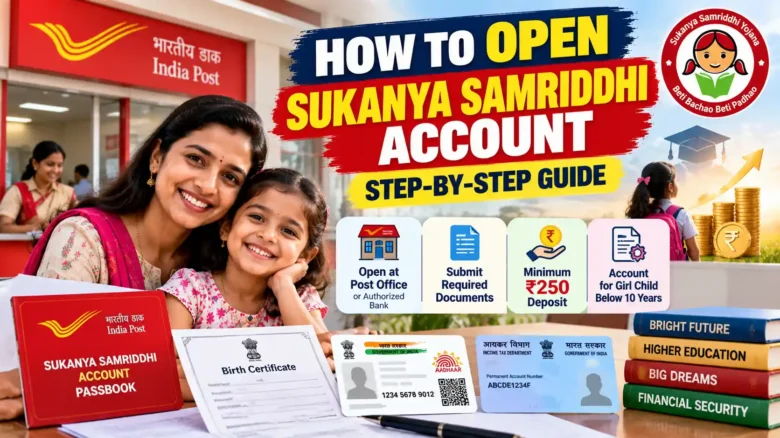
Securing a daughter’s financial future remains one of the primary goals for Indian parents, and the government-backed Sukanya Samriddhi Yojana (SSY) continues to be one of the most lucrative, secure, and tax-efficient small savings schemes available. Backed under the flagship Beti Bachao, Beti Padhao campaign, the Sukanya Samriddhi Account (SSA) delivers sovereign guarantee, high compound returns, and triple-tax-exempt (EEE) status.
As of October 2026, with recent regulatory updates around KYC verification, Aadhaar linking, and streamlined account operations, understanding the exact process to open and maintain an account is critical for parents and legal guardians.
Sukanya Samriddhi Yojana 2026: Overview Highlights
Before initiating the application process, here is an executive summary of the core metrics and features of the Sukanya Samriddhi Account:
| Parameters | Key Details (FY 2026-27 Updates) |
|---|---|
| Scheme Name | Sukanya Samriddhi Yojana (SSA / SSY) |
| Governing Body | Ministry of Finance, Government of India |
| Current Interest Rate | 8.2% per annum (Compounded annually) |
| Minimum Annual Deposit | ₹250 per financial year |
| Maximum Annual Deposit | ₹1,50,000 per financial year |
| Eligible Age | Girl child from birth up to 10 years of age |
| Account Limit | Maximum 1 account per girl; up to 2 accounts per family (3 in case of twins/triplets) |
| Deposit Period | 15 years from the date of account opening |
| Maturity Period | 21 years from account opening or upon marriage after age 18 |
| Tax Status | Exempt-Exempt-Exempt (EEE) under Section 80C of IT Act |
Eligibility Criteria for Opening an SSY Account
The rules governing the opening of a Sukanya Samriddhi Account are strictly enforced by the Department of Posts and authorized commercial banks to prevent duplication and ensure direct benefit:
- Age Criterion: The girl child must be an Indian resident and aged below 10 years on the day the account application is processed.
- Applicant Relationship: The account can only be opened and operated by a biological parent or a legally appointed court guardian until the child turns 18.
- Household Cap: A family can open a maximum of two accounts for two daughters. An exception is permitted for triplets or twins born after the first girl child, provided proper medical documentation and birth affidavits are produced.
- Residential Status: The girl child must maintain resident Indian status throughout the deposit tenure. If the beneficiary acquires foreign citizenship or becomes a non-resident Indian (NRI), the account must be closed prematurely without further accrual of interest.
Mandatory Documents Required in 2026
Under the revised financial transparency guidelines, physical documentation and electronic KYC matching are compulsory. Ensure you have original and attested copies of the following records:
- Birth Certificate of the Girl Child: Issued by the Municipal Corporation, Registrar of Births and Deaths, or recognized local civic body mentioning the child’s legal name.
- Identity Proof of Guardian: Aadhaar Card, Passport, Voter ID, or Driving License.
- Address Proof of Guardian: Aadhaar Card, utility bill, or domicile certificate matching the permanent address.
- Permanent Account Number (PAN): PAN card of the parent/guardian is mandatory for financial tracking. Form 60 is permitted only under select rural postal categories where PAN is yet to be generated.
- Passport-Sized Photographs: Two recent passport-size photos of the parent/guardian and the girl child.
- Medical Certificate (if applicable): Required only if claiming an exemption for twin or triplet births.
Step-by-Step Guide: How to Open Sukanya Samriddhi Account
While interest tracking and recurring deposits can now be managed digitally, the initial account opening requires an in-person KYC verification. Parents can open an SSY account at any authorized India Post Office or designated Public and Private Sector Commercial Banks (such as State Bank of India, Punjab National Bank, Bank of Baroda, HDFC Bank, ICICI Bank, and Axis Bank).
Phase 1: Procurement and Submission of Form
- Obtain the Application Form: Download Form-1 (Application for opening an account under National Savings Schemes) from the official India Post website or bank portal, or collect it directly from the local branch.
- Fill Required Particulars: Provide accurate information regarding the girl child’s legal name, date of birth, birth certificate registration number, guardian details, and residential address.
- Attach Document Duplicates: Affix self-attested photocopies of the child’s birth certificate, guardian’s Aadhaar, PAN card, and photographs.
Phase 2: Deposit and In-Person Verification
- Visit Branch: Present the completed application form along with original credentials for spot-verification at the branch counter.
- Submit Initial Deposit: Pay the opening sum (minimum ₹250, maximum ₹1,50,000) using cash, a local cheque, or demand draft drawn in favor of the branch postmaster or bank manager.
- Biometric & Aadhaar Authentication: The branch officer will complete the mandatory biometric or OTP authentication of the legal guardian in compliance with updated anti-money laundering (AML) directives.
Phase 3: Issuance of Passbook and Digital Linking
- Once authorized, the bank or post office generates an SSY Account Number and provides a dedicated passbook.
- The physical passbook records the child’s birth date, account opening date, account number, guardian details, and initial deposit amount.
- Enable Net Banking / IPPB: Request the linking of the SSY account to your internet banking profile or India Post Payments Bank (IPPB) mobile app to automate standing instructions and view electronic statements seamlessly.
Can You Open Sukanya Samriddhi Account Completely Online?
A widespread question among parents is whether the SSA can be opened entirely via an online paperless flow. As per prevailing Reserve Bank of India (RBI) and Department of Posts mandates, 100% online account opening without visiting a branch is not permissible. The physical submission of the child’s original birth certificate is legally required to verify date-of-birth authenticity and avert multiple account fraud. However, once the initial desk verification is completed, subsequent monthly contributions, balance inquiries, interest calculations, and automated mandates can be executed entirely online through net banking, mobile banking, or UPI via IPPB.
Important 2026 Operational Rules and Compliance Updates
The Ministry of Finance has streamlined operational guidelines to eliminate dormant or non-compliant accounts:
- Grandparent Guardianship Regularization: Under updated rules, grandparents are no longer recognized as legal guardians unless designated by a court order or upon the demise of both biological parents. Any grandfathered accounts operated by grandparents must have the biological parents’ KYC updated immediately.
- Penalty for Defaulted Accounts: If the minimum threshold of ₹250 is not deposited during a single financial year (April 1 to March 31), the account enters default. To revive a defaulted account, a fine of ₹50 per default year plus the arrears of ₹250 per missing year must be paid.
- Partial Withdrawal for Higher Education: Once the girl child attains 18 years of age or clears the 10th standard, up to 50% of the balance standing at the end of the preceding financial year can be withdrawn to finance genuine higher education expenses, verified against confirmed college admission letters.
Frequently Asked Questions (FAQs)
1. What is the maturity period of a Sukanya Samriddhi Account?
An SSY account matures 21 years from the date of its opening. Alternatively, if the girl child marries after reaching the age of 18, the account can be closed prematurely on the date of marriage, provided the closure application is made between one month before and three months after the wedding.
2. How many years do I need to deposit money into the account?
Deposits are required to be made for a duration of 15 years from the date of account opening. From the 16th year up to the 21st year, no further deposits are mandatory, but the accumulated corpus continues to earn prevailing government-notified interest rates until formal closure.
3. What happens if I forget to deposit ₹250 in a financial year?
If the minimum deposit of ₹250 is not credited in a financial year, the account is labeled as ‘defaulted’. You can reactivate it at your home branch by paying a regular penalty of ₹50 along with the minimum deposit amount of ₹250 for each lapsed year.
4. Can the SSY account be transferred if we relocate to another city?
Yes. The Sukanya Samriddhi Account is fully portable nationwide. It can be transferred free of charge from one post office to another, from a post office to an authorized bank, or across different commercial banks, simply by presenting proof of relocation of the guardian or beneficiary.
5. Is the interest earned on Sukanya Samriddhi Account taxable?
No. Sukanya Samriddhi Yojana enjoys complete Exempt-Exempt-Exempt (EEE) status. The annual investment qualifies for tax deductions under Section 80C (up to ₹1.5 lakh), the annual compounded interest is entirely tax-free, and the ultimate maturity payout carries zero tax liability.